
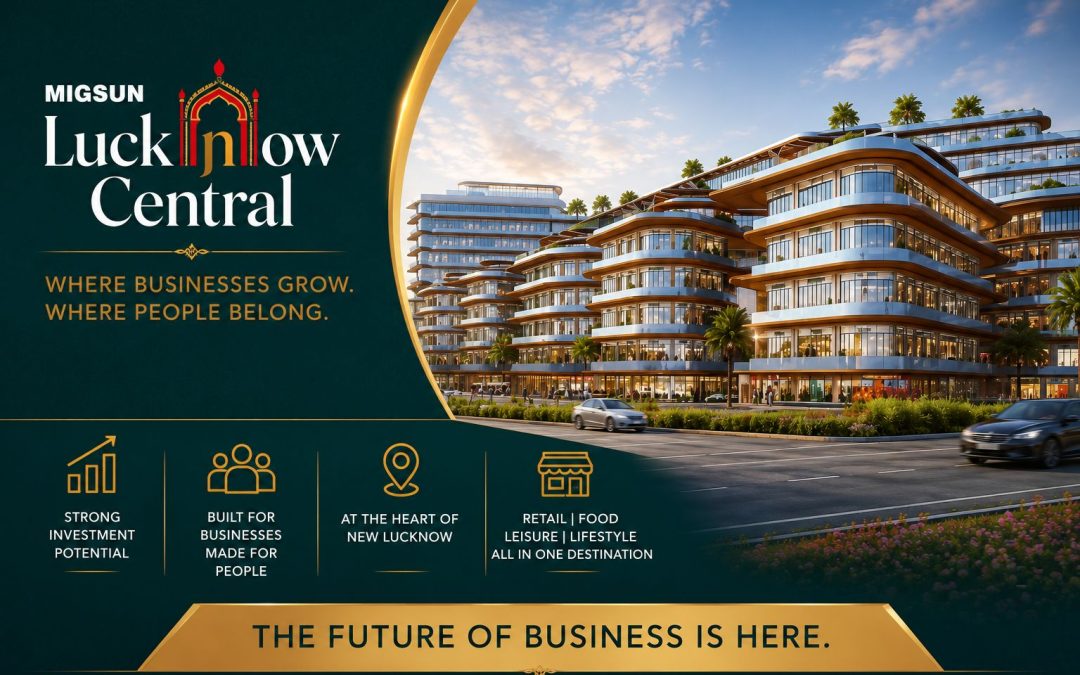
Commercial real estate has become one of the most discussed investment segments in recent years. Across cities like Noida, Gurgaon, Lucknow, and Greater Noida, developers are continuously launching high-street retail projects, shopping complexes, food courts, and mixed-use commercial hubs designed to attract both investors and businesses.
At first glance, many of these projects appear highly promising. Attractive brochures, modern architecture, assured return discussions, and future growth stories often create strong excitement in the market. However, the reality is that a large number of commercial projects struggle after possession.
Some face low footfall. Others experience vacant shops, weak leasing demand, poor customer engagement, or declining market activity. In many cases, projects that looked successful during launch phases fail to become active commercial destinations in real life.
This raises an important question for investors and retail businesses:
Why do commercial projects fail, and can Migsun Lucknow Central avoid those mistakes?
Understanding this requires looking beyond marketing claims and analyzing how commercial ecosystems actually work.
Commercial Success Is Not Created by Construction Alone
One of the biggest misconceptions in commercial real estate is that attractive infrastructure automatically guarantees success.
In reality, a commercial project succeeds only when people repeatedly choose to visit it.
Retail spaces survive on customer behavior. If consumers do not spend time inside a project, even premium-looking commercial developments can struggle over time. This is why many projects that appear impressive during launch phases later face issues such as:
- Vacant retail shops
- Weak footfall
- Poor rental demand
- Low business activity
- Limited repeat visitors
The true strength of a commercial project is not its exterior design—it is its ability to become part of daily consumer lifestyle.
Projects that fail to create this connection usually struggle to sustain long-term commercial momentum.
The Biggest Reason Many Commercial Projects Fail
The primary reason behind failure in many commercial projects is the lack of real organic demand.
In several cases, projects are sold aggressively to investors before actual business demand develops in the surrounding area. During launch periods, the focus often remains heavily centered on investment returns rather than long-term retail sustainability.
As a result, after possession:
- many units remain vacant,
- leasing activity slows down,
- and customer movement remains inconsistent.
A commercial project cannot survive only on investor ownership. It requires active businesses, regular visitors, and continuous commercial engagement.
This is where location and surrounding ecosystem become extremely important.
Understanding the Importance of Location
Retail businesses depend heavily on movement and accessibility.
Projects located in isolated areas often struggle because customers do not naturally visit them. Even strong marketing cannot permanently compensate for weak real-world demand.
This is one area where may have an advantage.
Lucknow itself is expanding rapidly as an urban and commercial city. Over the last few years, infrastructure development, residential expansion, road connectivity, and organized retail demand have increased significantly.
Consumers in tier-2 cities are also changing their preferences. People now prefer organized commercial environments where they can:
- shop,
- dine,
- spend leisure time,
- and access multiple services in one destination.
Projects positioned within developing urban corridors often have better chances of long-term commercial survival compared to isolated developments launched only for speculative investment purposes.
Why Footfall Matters More Than Fancy Architecture
One of the most common mistakes investors make is focusing entirely on project visuals.
Beautiful glass facades, premium interiors, and large launch events create excitement, but retail businesses think differently. Brands care more about whether customers will actually walk into the project regularly.
Footfall is the lifeline of commercial real estate.
Without customer movement:
- shops struggle to survive,
- rental demand weakens,
- and resale activity slows down.
This is why some older local markets continue performing strongly despite lacking modern infrastructure. Customers visit those places regularly because they fulfill practical daily needs.
For Migsun Lucknow Central, long-term success will depend less on launch marketing and more on whether it can generate sustainable consumer activity after completion.
The Role of Food & Lifestyle Businesses
Across modern retail markets, food and entertainment businesses have become major drivers of commercial success.
Consumers today are not attracted only toward shopping. They also seek experiences. Cafes, restaurants, dessert outlets, social spaces, and entertainment zones increase visitor retention and create repeat footfall.
This shift in consumer behavior has changed how commercial projects are designed.
Projects that successfully develop:
- food ecosystems,
- social gathering spaces,
- and lifestyle-oriented retail
often perform better than projects focused only on traditional retail shops.
If Migsun Lucknow Central succeeds in building an active lifestyle environment rather than functioning only as an investment-driven commercial complex, its long-term prospects could improve significantly.
Why Tenant Mix Decides the Future of Commercial Projects
Another major reason commercial projects fail is poor tenant planning.
A project filled with repetitive or poorly selected businesses usually struggles to maintain customer interest. On the other hand, balanced tenant mix creates stronger ecosystem value.
Successful commercial spaces generally combine:
- food brands,
- convenience retail,
- service businesses,
- fashion outlets,
- entertainment spaces,
- and daily-use stores.
This creates continuous customer circulation throughout the day.
When people visit a project for one purpose, they often interact with surrounding businesses as well. This ecosystem effect improves overall commercial sustainability.
For Migsun Lucknow Central, the quality of future tenant mix may become one of the most important indicators of long-term success.
The Risk of Investor-Dominated Commercial Projects
Many commercial developments face problems because too many units are purchased purely for investment purposes.
In such cases:
- actual business operators remain limited,
- leasing activity becomes inconsistent,
- and several shops remain non-operational.
This creates a weak commercial atmosphere, which further reduces customer attraction.
A project dominated by vacant units can quickly lose market momentum.
This is why genuine end-user business participation matters far more than temporary launch demand.
If Migsun Lucknow Central manages to attract actual businesses instead of depending only on speculative investors, it may avoid a common problem faced by many commercial developments.
Consumer Behavior Is Changing Rapidly
Retail real estate today is very different from what it was ten years ago.
Online shopping, food delivery platforms, digital payments, and changing urban lifestyles have transformed how people interact with physical retail spaces.
Modern consumers no longer visit commercial destinations only to purchase products. They prefer locations that offer:
- convenience,
- social experience,
- entertainment,
- comfort,
- and lifestyle value.
Commercial projects that fail to adapt to this shift often struggle to maintain relevance.
For projects like Migsun Lucknow Central, success may depend on whether the development evolves into a lifestyle-driven destination rather than functioning only as a shopping complex.
Can Migsun Lucknow Central Avoid These Mistakes?
While every commercial project carries risks, Migsun Lucknow Central appears to have certain factors working in its favor.
The project benefits from:
- Lucknow’s expanding urban growth,
- increasing organized retail demand,
- improving infrastructure,
- and rising consumer expectations in tier-2 cities.
However, avoiding failure will ultimately depend on execution.
The project’s future performance may rely on:
- occupancy quality,
- tenant planning,
- maintenance standards,
- customer convenience,
- and long-term footfall generation.
Commercial success is rarely achieved immediately after launch. Strong retail ecosystems usually develop gradually over time through consistent consumer engagement.
If the project succeeds in becoming a destination people genuinely choose to visit repeatedly, it may establish itself as a meaningful commercial hub in Lucknow’s evolving retail landscape.
Final Thoughts
Commercial real estate is often marketed through promises of returns and future growth, but the reality is far more complex.
Many projects fail not because construction is poor, but because they fail to create sustainable consumer ecosystems. Without real footfall, active businesses, and strong tenant engagement, even visually attractive projects can struggle.
has the potential to benefit from Lucknow’s growing commercial environment and changing urban lifestyle patterns. Yet its long-term success will depend on something far more important than marketing campaigns:
Can it become a place where businesses thrive because people genuinely want to spend time there?
If the answer becomes yes, the project could avoid many of the mistakes that have caused other commercial developments to fail.